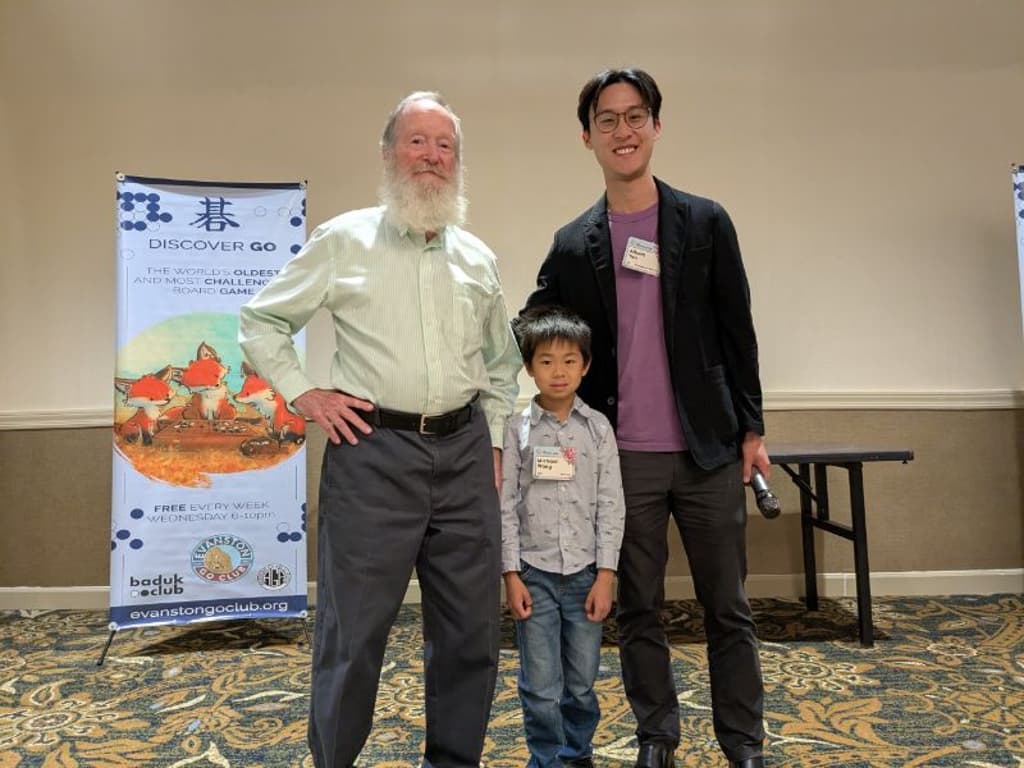
Bob Barber, Michael Wang, and Albert Yen (left to right) pose for the honorable mention award at the 2026 Chicago Open awards ceremony. Photo by Xinming Guo.
At the 2026 Chicago Open in May, Bob Barber stood alongside 6-year-old Michael Wang to receive a Fighting Spirit honorable mention.
The tournament brought 100 players to Evanston, a long way from the Chicago tournaments Barber first began directing decades ago.
Now 80, Bob reflected on how much those tournaments have changed.
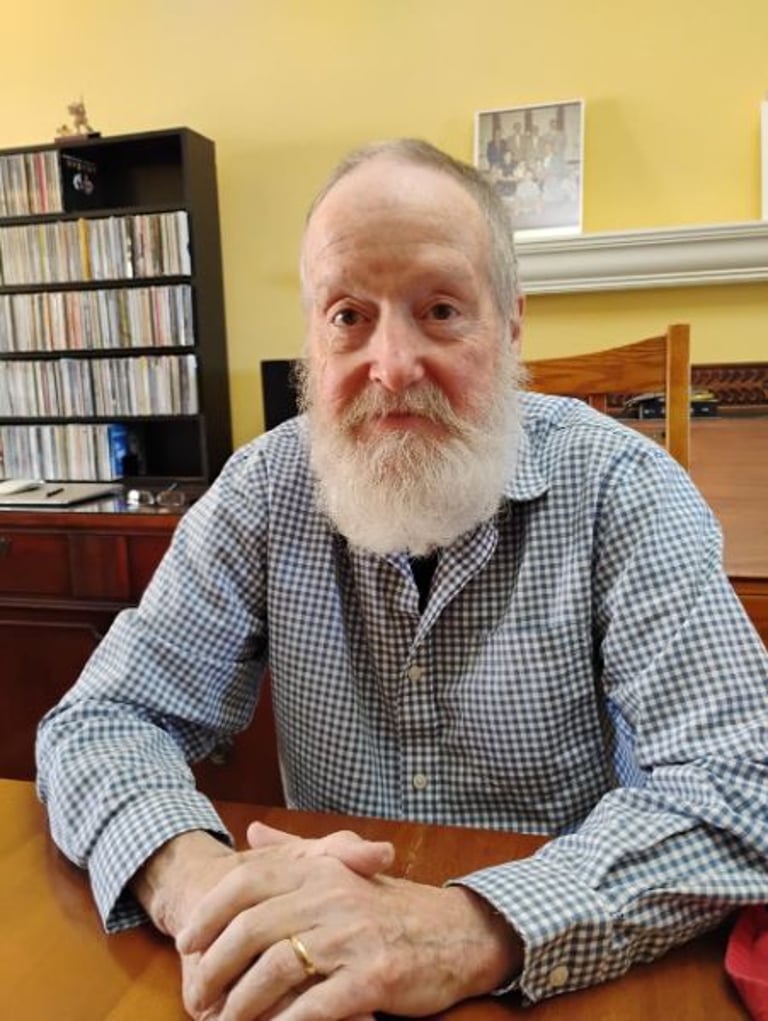
Bob Barber, now 80, celebrates more than four decades of involvement in Go. Photo courtesy of Bob Barber.
“Of course, now it’s a big deal, and we have over 100 players. And a person couldn’t do that on pencil and paper as I used to.”
Barber would know. For nearly two decades, he directed quarterly tournaments in Chicago, handling the pairings and results by hand.
A Tepid Start
Barber’s path into that role began much less deliberately.
“I bought a set in ’65, but didn’t start playing till ’82 because there was no one to play with,” he said. “There was no internet. There were no books. There were no professionals.”
The opportunity finally came through a change in his personal life.
“Finally, in ’80, I got married, and the neighborhood I moved into had a coffee house, No Exit, where people played Go,” Barber said. “It was my neighborhood, so that was the beginning.”
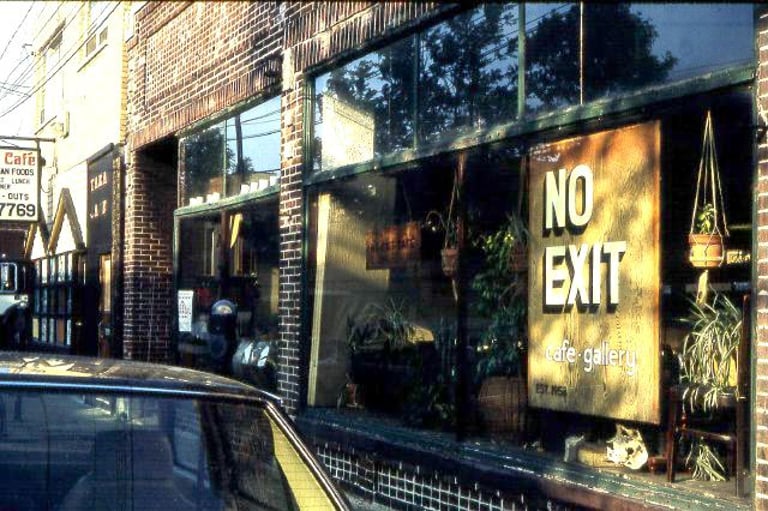
No Exit Café in Chicago’s Rogers Park neighborhood, where Barber began playing Go regularly in 1982. Source: https://drloihjournal.blogspot.com/2022/10/the-no-exit-cafe-history-chicago-illinois.html.
What kept him playing is harder for Barber to explain.
“I don’t know why I play. I don’t know why I started. I quit for seven years. I don’t know why, and I’m back, and I don’t know why,” Barber said. “The game itself, of course, is fantastic, but the people who play Go are wonderful people, and they’re all now very welcoming. [They] try to make everybody better.”
Eventually, Go took him beyond Chicago.
“Somehow I heard about a Go tournament in Ann Arbor. That was my first, and I went, and then eventually Roger White from the American Go Foundation kept bugging me to hold my own tournament here in Chicago,” Barber said. “So I did.”
The Barber Era
Barber credits much of his tournament style to the organizers he met in Ann Arbor.
“I’m not a leader. I’m a follower, so I just copied the Ann Arbor method,” he said. “His idea was to have instant Go, just instant pairing: finish a game, and you play somebody else if you want to. And we didn’t have rounds, so that’s the way I ran it continuously.”
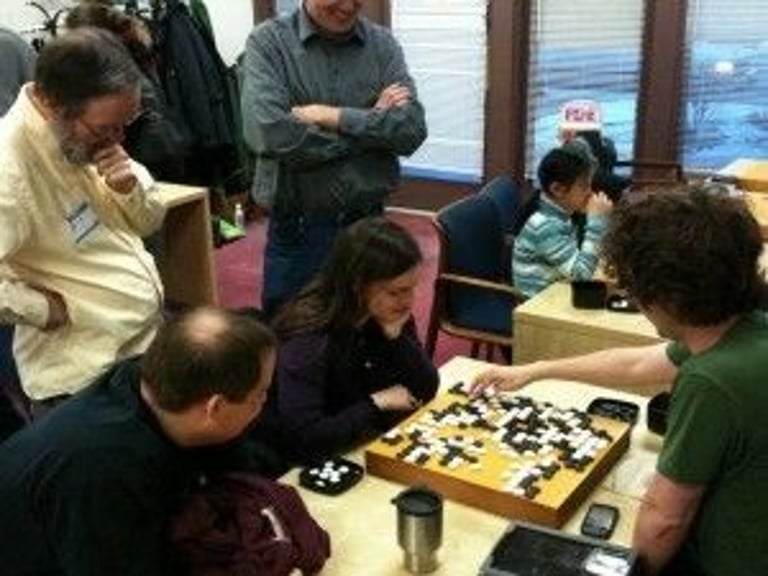
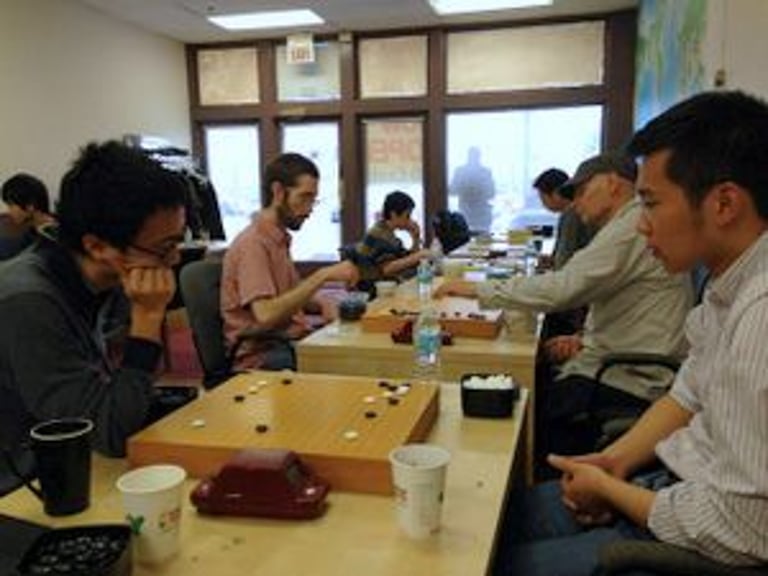
A crowd gathers around a game at Barber’s Dec. 11, 2010, Chicago Winter Tournament. Twenty-nine players attended despite severe weather warnings. Photo by Mark Rubenstein. Source: https://aga-news-archive-viewer.azurewebsites.net/api/news-archive/article/7314.
Players compete at Barber’s Dec. 1, 2012, “Entertainment for Menschen” tournament in Chicago. Photo by Mark Rubenstein. Source: https://aga-news-archive-viewer.azurewebsites.net/api/news-archive/article/6105.
In a previous recollection, Barber specifically credited late tournament organizer David Relson.
“When I finally relented, I based it entirely on David Relson’s pattern, including the post-tourney pizza party,” Barber wrote.
Back in Chicago, Barber recreated that system without the software tournament directors have today. Pairings, results and much of the event were handled by hand.
“Some of them were almost impossible because there were separate cubicles, and I had to run around and get results,” Barber said. “Go players, they weren’t always so quick to report to the TD. They wanted to review immediately.”
Finding a place to hold the tournaments was another challenge.
“For years, we just flew under the radar and we just showed up,” Barber said. “And if there was a room available, we just took over.”
Still, Barber remembers the work simply.
“So it was all fun.”
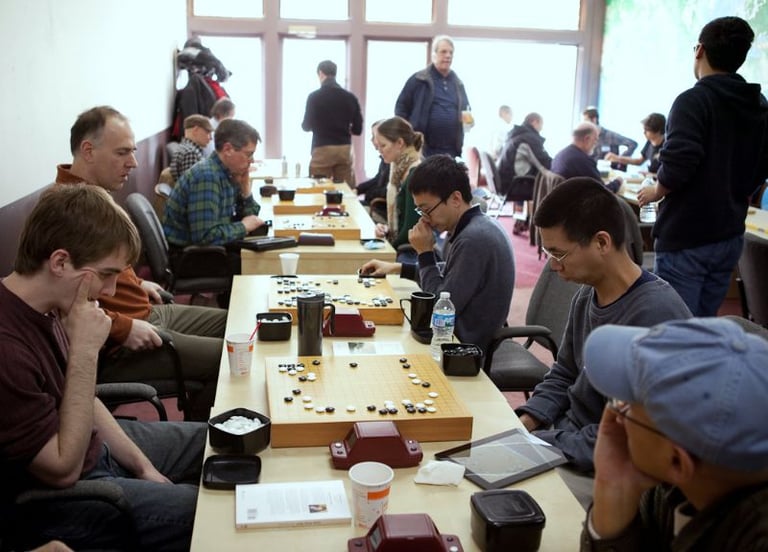
Players compete at Barber’s “I Sing the Body Electric” tournament on Feb. 11, 2012, at the Go Center in Arlington Heights, Ill. The 42-player field set a record for the venue. Photo by Daniel Smith. Source: https://aga-news-archive-viewer.azurewebsites.net/api/news-archive/article/6612.
And while Barber calls himself a “follower,” some parts of a Bob Barber tournament were unmistakably his own.
Perhaps most recognizable were the names.
Barber gave his events titles including “I Sing the Body Electric,” “Entertainment for Menschen” and “Fan Mail from Flounders.” His favorite came from an unlikely combination of presidential politics and Japanese vocabulary.
“My favorite, I called it Nader’s Nadare,” Barber said. “Ralph Nader was running for president, and nadare is avalanche. There was no way in heck that Nader was going to win, but that’s what I called it. Keith Arnold complimented me on the name; it tickled him.”
For inspiration, Barber drew on the same resource he worked around for decades as a librarian: books.
“I would go to the library and look up what happened on this date around the world, or what was important in Chicago,” he said. “So I did a lot of Chicago things.”
Over roughly two decades, his quarterly tournaments became a fixture of the Chicago Go calendar. Barber ultimately directed around 80 of them.
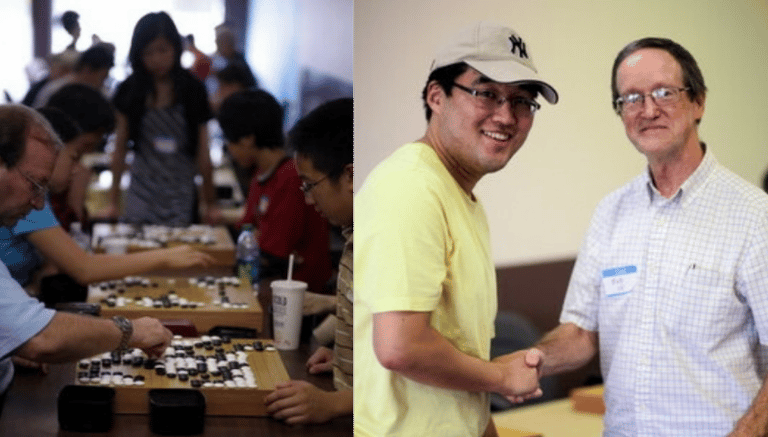
Players compete at Barber’s Sept. 3, 2011, “Form Follows Function” tournament in Chicago (left); tournament winner Xuyu Xiang 6D with Barber (right). Photos by Dan Smith. Source: https://aga-news-archive-viewer.azurewebsites.net/api/news-archive/article/6826.
Giving a Bit More
Beyond his Chicago tournaments, Bob also contributed nationally.
“I think I’ve always been so impressed with the national organization—Terry Benson, Chris Kirschner, Chris Garlock, Keith Arnold, just to name a few, folks like that that just give so much—so I decided to give a bit also,” he said.
That “bit” eventually included service on the American Go Association Board representing the Central Region, work as the AGA’s Congress liaison and leadership of the 2002 U.S. Go Congress in Chicago.
“I think we had 235 players, perhaps, in ’02,” Barber said. “Now they have 400—more than 400.”
His time as Congress liaison also gave him a new appreciation for the work required.
“Chris Kirschner was the Congress liaison for years, and he talked me into it, and I took it on,” Barber said. “Then I found out if you’re the Congress liaison, it’s Congress liaison every day of the rest of your life.”
Still, he reflected fondly on the 2002 Congress, recalling his most vivid memory from playing Japanese professional Nakayama Noriyuki 6P.
“[Nakayama] was a lot of fun, and one of his traditions was to play a game against the tournament director, who was me,” Barber said. “He gave me six stones, and his challenge to himself was to win by exactly six points.”
Barber, a 1K, made Nakayama’s challenge difficult.
“At one point, he made me take a move back because he was going to win by too much.”
Beyond the Tournament Hall
Tournaments were only one way Barber tried to put Go in front of new players. He helped start the Go Club at UIC and taught at events including Anime Central and Japan Fest, to name a few.
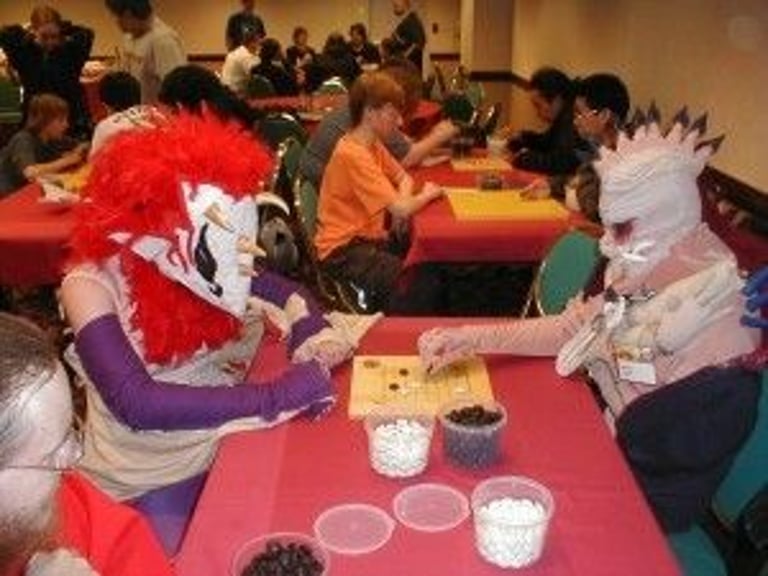
Attendees learn Go at Anime Central in 2006. Barber was among the Evanston Go Club volunteers who taught at the convention. Photo by AGA. Source: https://www.usgo.org/content.aspx?page_id=5&club_id=454497&item_id=112900.
With Evanston Go Club President Mark Rubenstein, Barber also turned to PechaKucha—Japanese for “chit-chat”—a presentation format created in Japan. The two used the format first for a general introduction to Go and later for a presentation focused on AI and Go.
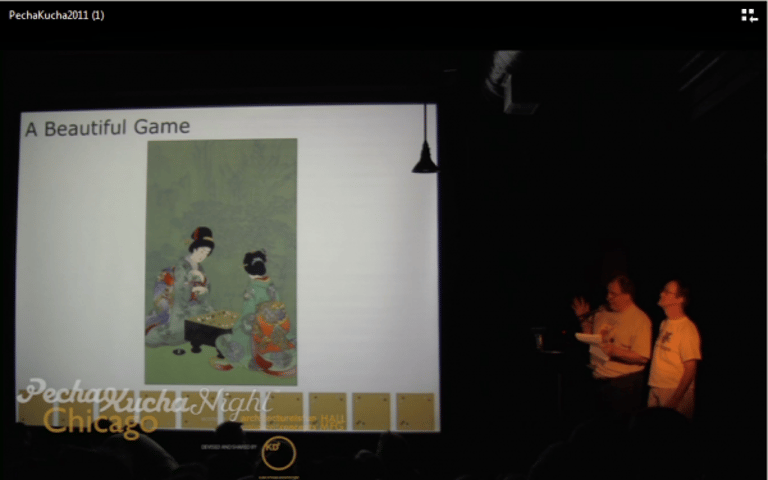
Mark Rubenstein (left) and Bob Barber (right) present “A Beautiful Game” at PechaKucha Night Chicago in 2011. Photo courtesy of Mark Rubenstein. Source: https://aga-news-archive-viewer.azurewebsites.net/api/news-archive/article/2642. The presentation can be viewed here: https://www.youtube.com/watch?v=mffjg1pRtaE.
“They were so bored sitting through these demonstrations and presentations,” Barber said of its creators. “So they said, ‘Here’s what you’re going to do: you get 20 slides, 20 seconds each, 400 seconds, and then you’re out.’”
Additionally, earlier this year, Barber joined other local players teaching visitors at JapanFest throughout the day.
“There was just hundreds of folks,” he said. “We had a lot of teachers. People were interested.”
On a smaller scale, the same thing happens each week at the Evanston Go Club, which currently meets at a Starbucks near Northwestern University.
“We had a couple of beginners, we have beginners almost every week,” he said.
Even so, Barber is modest about how much the game has grown.
“I’ve been pushing this game for 40 years without much success,” he said. “But you see that the Congress is growing, and now we have four clubs in Chicago, so there is some traction.”
The Evanston club became an important part of that growth for Barber personally. When No Exit Café closed, he said, his regular Go community shifted north to the club Rubenstein had started.
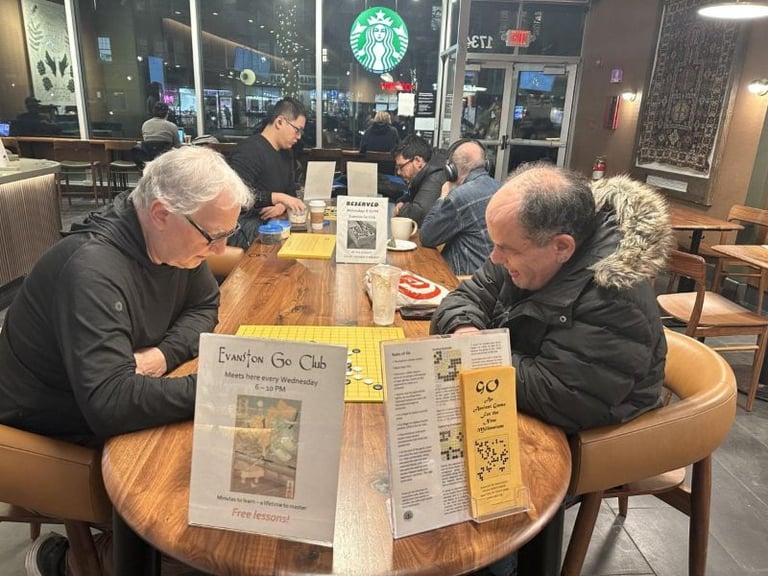
Evanston Go Club founder Mark Rubenstein (left) plays during a Wednesday night club meeting at Starbucks near Northwestern University. Photo by Maya Heyman/The Daily Northwestern. Source: https://dailynorthwestern.com/2026/01/14/city/evanston-go-club-marks-30-years-of-community-and-competition/.
Passing the Torch
After Barber stopped directing, Rubenstein eventually picked up the tournaments. Years later, another familiar face joined him.
Albert Yen had first come to Barber's events as a child.
“His mother brought him to the first tournament, maybe to several, and we said, ‘Well, they got a special child rate. He can join for $10,’” Barber recalled. “She said, ‘We want the lifelong.’ Well, they knew, of course—they knew they were in it for the long haul."
Barber remembers Yen standing out almost immediately.
“He would come to our tournaments and win all his games,” Barber said. “He was either 5D at 6 or 6D at 5, one of those two.”
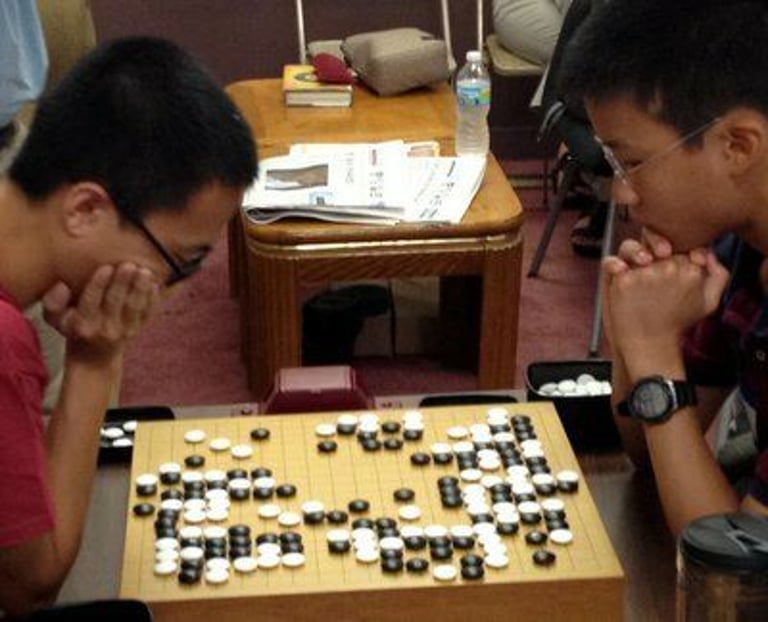
Twelve-year-old Albert Yen 6D (right) plays Changyu Han at the Sept. 1, 2012, “Me Tarzan” tournament in Chicago. Yen finished undefeated to take first place in the Dan division. Photo by Mark Rubenstein. Source: https://aga-news-archive-viewer.azurewebsites.net/api/news-archive/article/6247.
Yen, already an exceptionally strong player as a young child, became a regular presence at Chicago tournaments. Decades later, their roles have nearly reversed.
“I made my first move and I put my stone the way I like to, upside down, and he turned it over,” Barber recalled of a more recent tournament. “I said, ‘Okay, Albert, you’re the boss.’”
“I had it at the university, and then we had it at the Korean Go Club, and then Mark moved it into a church,” Barber said. “But now… they’ve outgrown that and they’re in [the Holiday Inn]. Everything’s in the one building. It’s all organized. They got their own rooms. Mark, Simon, Albert, what they do is great.”
Across decades of E-Journal reports, tournament results and organizational work, Barber’s name appears again and again.
When asked what he was most proud of, he thought for a bit.
“Well, I guess 80 tournaments, that’s a lot,” he said. “And that Albert … remembers me and … he knows that I did my share.”
This fall, he is once again helping make a Chicago tournament possible.
The 2026 Chicago Rapid
Bob Barber generously donated $1,000 to the 2026 Chicago Rapid in memory of his late brother, Terry Barber.
“My brother… died and left me some money… and I am a man of few desires,” Barber said. “So I looked around. I said, ‘Do I want a new bicycle hat? Do I want some expensive shoes?’ I couldn’t think of anything I really wanted, so I said, ‘This is a way to give some of it.’”
The donation also supports the kind of Go Barber values most.
“There’s nothing like face-to-face Go,” he said. “You’ve got a timer, and it’s nice and quiet, and you’re with people who love Go, and you’re stronger than some, and you’re weaker than some, and it’s just fabulous.”
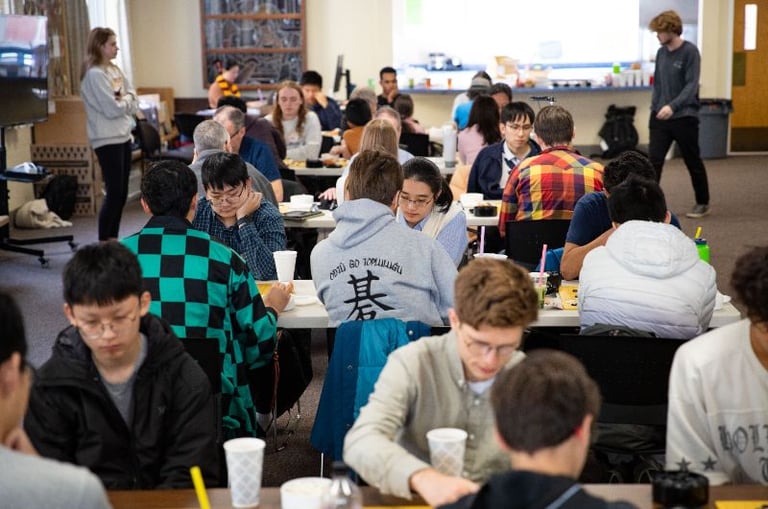
Players compete at the 2025 Chicago Rapid. Photo by David Schiller.
Barber’s $1,000 sponsorship helped the Chicago Rapid move to the Holiday Inn for the first time and gave NextMove room to experiment with new ideas, including a travel initiative for players whose winners will be announced soon.
For Yen, Barber’s impact extends beyond this one tournament.
“His story is for us to continue,” Yen said.
For twenty years, Bob Barber named Chicago tournaments. This fall, decades after his first, he gets to name another one.
2026 Chicago Rapid: Four Score, One Grand, and a Bridge to the Future
The Chicago Rapid will celebrate Bob’s eighty tournaments, one generous gift, and a tradition that continues here in Evanston.